
Sevier County Court Records After a Jail Arrest
After an arrest in Sevier County, a person who is held locally is booked at the Sevier County Jail. The court record starts when the Sevier County Attorney's Office screens the case and files charges in the proper court. The official Sevier County Attorney page names Casey Jewkes as county attorney and describes the office's role prosecuting felony, misdemeanor, and juvenile crimes that occur within Sevier County.
The jail side and the court side answer different questions. Current custody, release eligibility, and booking details belong with jail inmate records. Booking photos and photo-request limits belong with jail mugshots. The court record is where filed charges, hearings, judgments, warrants, pleas, dismissals, convictions, sentencing, and sealed-record limits are tracked.
How to Find Sevier County Court Records After an Arrest
Utah Courts Xchange is the public case-search route for district and justice court case summaries. Utah Courts describes Xchange as a repository of case information entered by court staff, including party names, judges, attorneys of record, documents filed, hearings, judgments, and outcomes. District court handles felony and class A misdemeanor cases; justice courts handle many class B and C misdemeanors, infractions, and traffic matters.
The Utah Courts Xchange information page explains the court-record coverage at utcourts.gov.
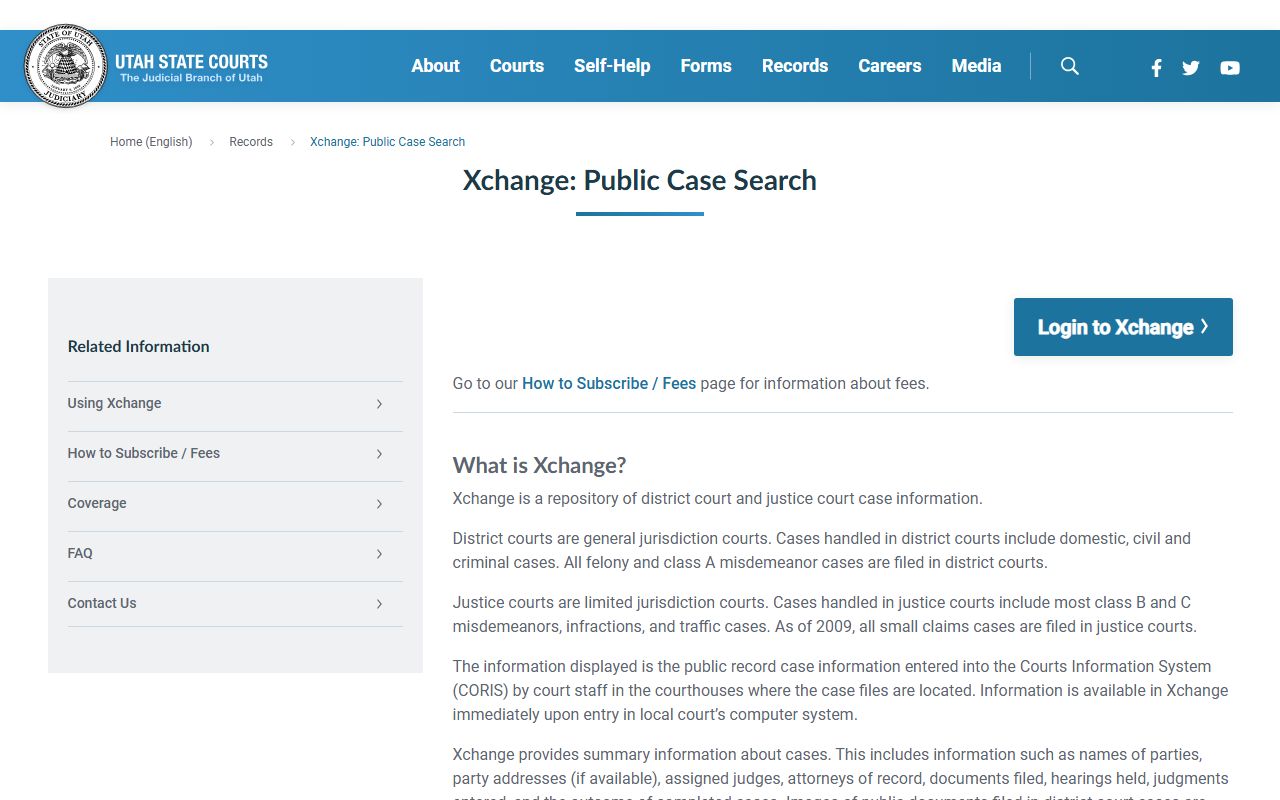
Use that court source for the formal case record, then compare it with jail custody information because court entries can lag a recent booking.
- Confirm the person is or was in Sevier County Jail by calling the jail at (435) 896-2660 when the online roster is unavailable.
- Open Utah Courts Xchange and search by defendant name or case number.
- Check whether the case is in Sixth District Court, Sevier County Justice Court, Salina City Justice Court, Aurora City Justice Court, or another listed court.
- Read each charge for the offense level, filing date, amended status, hearing history, bond orders, and disposition.
The Xchange search interface is the public entry point for name and case-number searches.
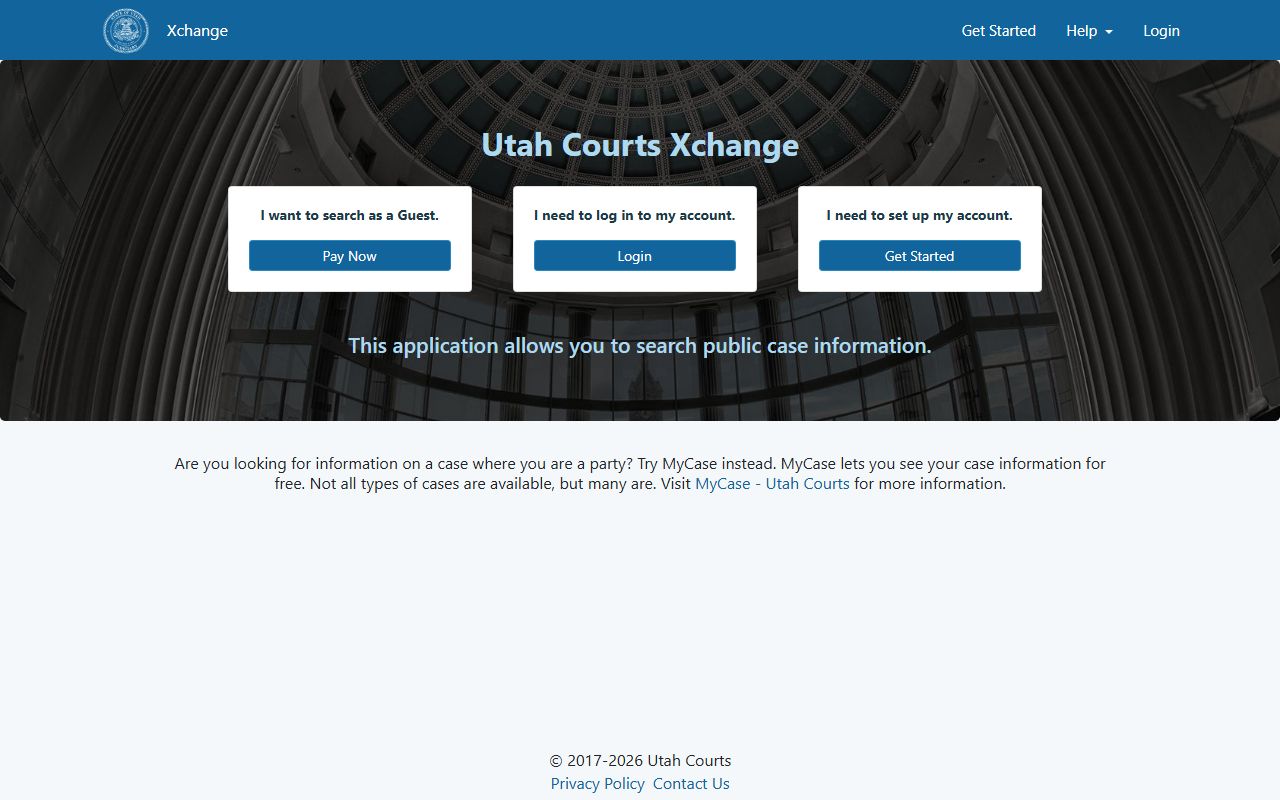
Xchange may be searched as a guest or through an account depending on the task, and district-court document images that are public can be purchased through the court system.
Xchange Search Fields for Court Records After an Arrest
Research did not capture every live field on the Xchange form, but Utah Courts identifies the main routes used for case lookup. Use the narrowest known identifier first, then widen the search if a recent arrest has not yet appeared in the court index.
| Search Route | Type | Use | Notes |
|---|---|---|---|
| Login or guest access | Account route | Entry to public case search | Some use may require account setup or fees governed by Utah Courts. |
| Party or defendant name | Name search | Search when the case number is not known | Name spelling and date of entry can affect results. |
| Case number | Identifier search | Search when a citation, clerk, or attorney provides the case number | The most direct path when available. |
| Court or case type | Filter | Separate district court from justice court matters | Coverage depends on court type and CORIS conversion history. |
How Charges Get Filed After an Arrest: Complaint, Information, and Indictment
A booking charge is an intake description from the arrest side. A court charge begins with a charging document filed by the prosecutor or otherwise authorized through the court process. In Sevier County, felony and class A misdemeanor filings generally route to Sixth District Court, while lower-level misdemeanors, infractions, and traffic matters generally route to justice court.
| Document | Who Files It | Common Use | What to Check |
|---|---|---|---|
| Complaint | Prosecutor, often based on officer reports | Many criminal cases, especially early filings | Offense code, level, probable-cause allegations, and first hearing. |
| Information | Prosecutor | Many felony filings after screening | Filed counts, amended counts, and bindover or arraignment activity. |
| Indictment | Grand jury process | Less common, serious cases | Charges returned and later district-court proceedings. |
Charge Status and What It Means
Filed charges can change after the first court record appears. The prosecutor may amend a count, reduce the level, add a charge, dismiss a count, or decline to proceed. That is why an arrest charge on a booking record should not be treated as the final court outcome.
| Status | What It Means |
|---|---|
| Pending | The charge or case is unresolved and future hearings or filings may still occur. |
| Filed | The prosecutor has formally initiated the charge in court. |
| Amended or Reduced | The filed charge changed, often by offense wording, code, or severity level. |
| Dismissed | The charge ended without a conviction on that count. |
| Plea in Abeyance | A plea is held under conditions, and successful completion may lead to dismissal. |
| Convicted or Sentenced | Guilt was entered by plea or verdict, and the court imposed an order or sentence. |
| Acquitted | A not-guilty finding was entered on that charge. |
Bond and Pretrial Release After an Arrest
Bond and release decisions are court-driven. Sevier County's pretrial release material says a judge determines conditions intended to secure court appearance and protect public safety. Conditions can include GPS monitoring or alcohol monitoring, and the county lists a one-time $60 supervision fee for pretrial release. For supervision questions, the sheriff material lists Deputy Ryan Jensen at (435) 893-6480 and Deputy Brooke Moosman at (435) 709-5411.
| Release Type | How It Works |
|---|---|
| Cash Bond | The full cash amount is paid to secure release if the person is eligible. |
| Surety Bond | A commercial bail agent posts surety, usually for a fee. The sheriff app lists local bail-bond company names and phone numbers without endorsing terms. |
| Personal Recognizance or Pretrial Release | The defendant is released under court conditions instead of posting the full cash amount. |
| No-Bond or Hold | Release may be blocked by another case, warrant, UDC hold, parole or probation hold, federal hold, or immigration detainer. |
Warrants That Lead to a Sevier County Arrest
No official Sevier County active warrant list or public sheriff warrant search was located in the research. A warrant arrest can still create a jail booking first and a court update later. For a possible warrant booking, use the sheriff's official inmate-search route and call Sevier County Jail at (435) 896-2660. For general warrant or records questions, call the Sheriff's Office at (435) 896-2600. Xchange may show bench-warrant events, hearings, and orders when they are part of a public court case.
Bench warrants from Sevier County Justice Court, Salina City Justice Court, Aurora City Justice Court, or Sixth District Court may not appear in a sheriff web search. A GRAMA request to the Sheriff's Office can be used for warrant or arrest records, subject to law-enforcement, safety, privacy, and protected-record limits. The sheriff's records-request material is published through the official records request source.
Charges vs. Convictions in Court Records After an Arrest
An arrest and a filed charge are not the same as a conviction. Utah Courts explains criminal offense classes and penalties, but the conviction question depends on what happened in the case: plea, verdict, dismissal, acquittal, or sentencing.
| Charge | Conviction | |
|---|---|---|
| Stage | An accusation filed in court after arrest screening. | A guilty plea, guilty verdict, or other adjudication of guilt. |
| Proof Standard | Often starts from probable cause and prosecutor screening. | Requires proof beyond a reasonable doubt or an accepted plea. |
| Record Meaning | Shows what was alleged and how the case is moving. | Shows the final guilt finding and often the sentence or order. |
Sealed vs. Expunged Court and Arrest Records
Utah Courts explains that expungement seals government records from public view. Utah Code 77-40a-302 provides a petition route for eligible arrest, investigation, and detention records. Utah Courts also notes automatic expungement changes effective January 1, 2026. Xchange does not display sealed or expunged cases, and juvenile delinquency, child-welfare, and termination cases are also excluded from public display.
| Sealed | Expunged | |
|---|---|---|
| Public Visibility | Hidden from ordinary public inspection. | Sealed from public view through the Utah expungement process when eligible. |
| Access Limits | Courts and agencies may retain limited access under law. | Government access may still exist in specific legally allowed situations. |
| Where to Verify | Contact the court clerk when Xchange does not show the case. | Use Utah Courts expungement resources and the court that handled the case. |
Restricted Court Records After an Arrest in Sevier County
Utah GRAMA starts with a public-records framework, but records can be private, controlled, protected, sealed, expunged, or restricted by another statute. Utah Code 63G-2-305 covers protected records, including some law-enforcement records. Records tied to ongoing investigations, safety concerns, privacy interests, juvenile matters, sealed charges, or expunged cases may be withheld or absent from public search results.
Background Check Considerations
Casual court lookup is not the same as a legally compliant background check. Court records after an arrest should be verified with the originating court, the Sevier County Attorney's Office, or the Sheriff's Office before anyone relies on them for a legal, custody, or records decision.
Important: This website is not a consumer reporting agency and may not be used for FCRA-covered screening decisions.